

Recently we have been made aware that our church organ is actually an instrument of special interest. Our Choirmaster, David Cook explains.
Last summer I discovered that the small and perfectly formed 122 year old Lewis organ that graces our church has an almost identical twin! I saw it in the Historic Organ listing scheme run by the British Institute of Organ Studies (BIOS). This lists some 1,209 organs in the UK that are regarded as being of crucial to the heritage of British organ building and are outstanding examples of the work of British organ builders.
The organ in the parish church of Langbank, Strathclyde, had the same organ builder – Lewis and Co., similar date – 1903 and a virtually identical stop list. It had been awarded a Grade II listing meaning that it was an organ of “special interest”. If that organ could get a listing, why not Keston?
I filed an application to BIOS for the Committee to consider, but several queries were raised about the origins of the organ. The stop list was not typical of a Lewis organ. Dr William McVicar, Chairman of BIOS, was dispatched to view our organ. Fortunately, Dr McVicar lives locally and a visit was arranged. He appeared, along with his dog Pluto who was not too keen on the frequencies of the high notes! Removing one of the front pipes to gain access to the organ Dr McVicar brandished a selfie stick, attached his phone and proceeded to put it into the organ case to take photos.
His subsequent report to the HOLS committee stated that the organ “looked to be entirely the work of Lewis and Co., that it was unusual in its specification, had a wide variety of stops, the pipe work was original, and had had only minor alterations and had been well restored”.
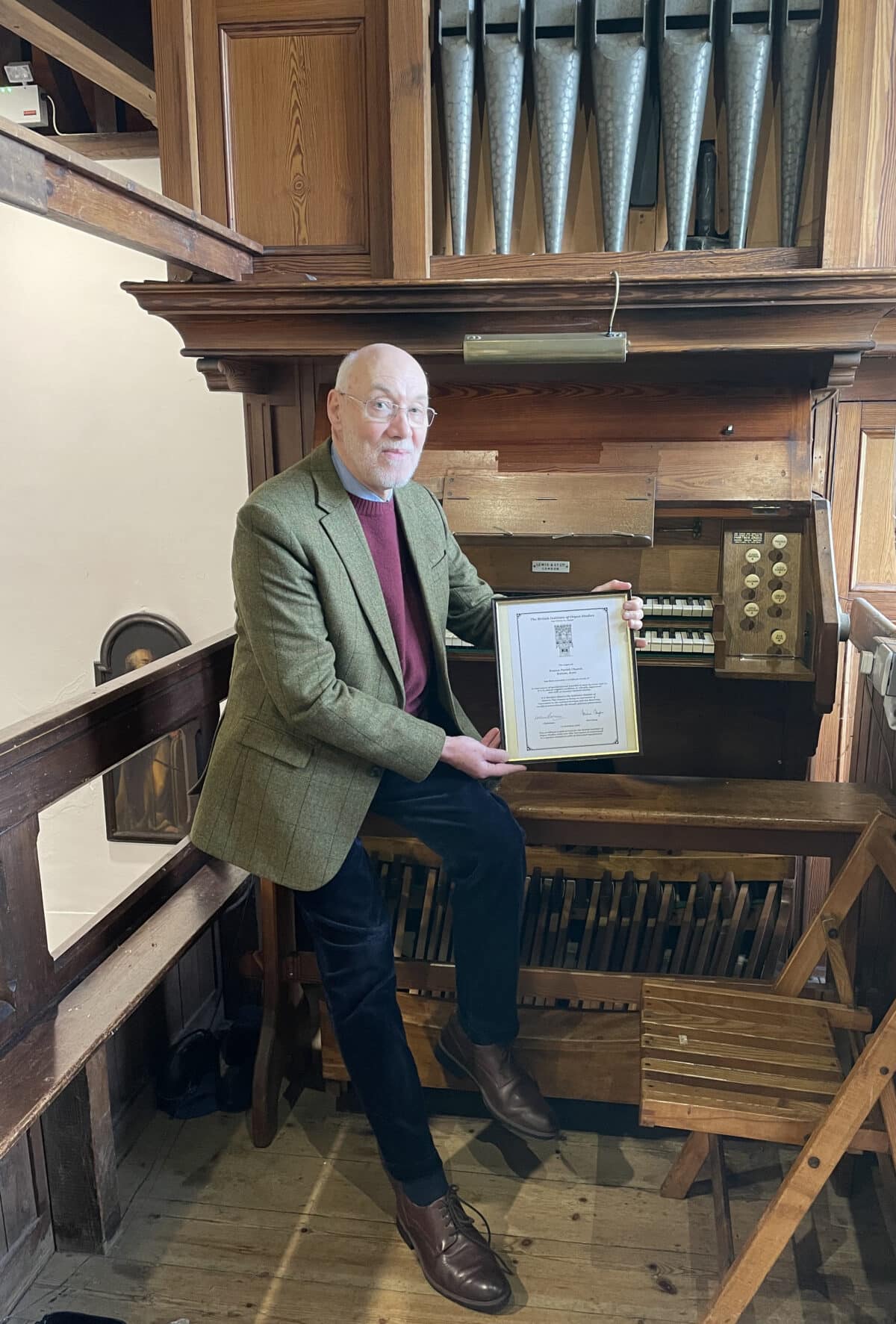
The report did the trick and at the January 2026 meeting of the BIOS Council our application was approved and Keston Parish Church Organ was awarded Grade II * listing, (the same as the church), and certified as being “an instrument of special interest installed in 1904 by Lewis and Co. It is in almost original condition, is robustly engineered and with an unusual musical scheme… and is an instrument of importance to the national heritage and one deserving careful preservation for the benefit of future generations”.
However, it should be noted that it is the organ, not the Organist (48 years and counting at Keston) which has been granted Historic Listing!
David Cook, Organist and Choirmaster